Before you read on, you might want to download this entire revision notes in PDF format to print it out for your child, or yourself to read it later.
This will be delivered to your email inbox.
Ultimate Guide To Biological Evolution
Introduction
We live in a diverse world, full of flora and fauna composed of millions of distinct species. How did this level of diversity happen? The answer lies in biological evolution. Evolution and diversity are intrinsically linked, resulting from the interactions between organisms and their environments, and the consequences of these interactions over (very) long periods of time. Through natural selection, evolution drives gradual changes in inherited characteristics within populations over generations. This change, over time will lead to the emergence of new species and diversity of life.
Darwinism
Darwinism, founded by Charles Darwin, refers to the theory of biological evolution driven by natural selection. Sometimes referred to as “survival of the fittest”, Darwinism suggests that some organisms were better adapted to their environment than others, allowing them to survive and produce the most offspring. These offspring are a testament to their parents’ successful survival, and continue to pass on their genes to their own offspring over generations.
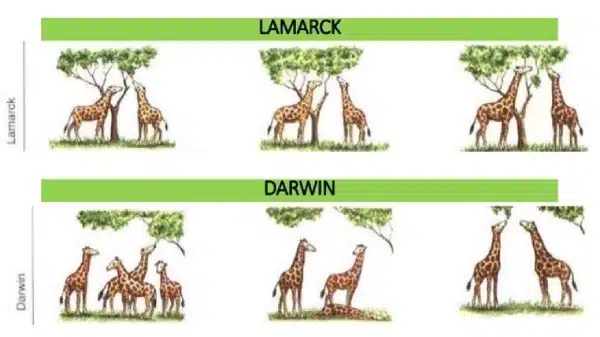
Before Darwinism, Jean-Baptiste de Lamarck had attempted to offer an explanation for evolution based on fossil records. Lamarck proposed that evolutionarily advantageous traits were attained through “use or disuse”. For example, a giraffe’s long neck that allows it to reach high trees was attained through constant training and lengthening (use of the advantageous trait). Meanwhile, flightless birds like kiwis would develop smaller wings since they are not used for flight. Over time, these traits become “locked in” and passed down to offspring.
Darwinism on the other hand, suggests that instead of striving to attain advantageous traits over a lifetime, some individuals were simply born blessed with the advantageous trait. A Darwinian perspective on the giraffe neck would suggest that some giraffe ancestors were born with longer necks, which allowed them to reach higher into trees and eat more food. These individuals are hence likely to receive better nutrition and outlast those with shorter necks, and are thus more successful and fit. These “fitter” individuals would live longer and leave behind more long-necked offspring, allowing the long-necked trait to be passed down over generations.
Fig 1. Illustration describing the difference between Lamarck and Darwin’s theories of evolution. Following Lamarck’s ideas, the giraffes’ ancestors all start with shorter necks. Due to the need to reach food in taller trees, individuals are driven to stretch their necks. These individuals are able to reach more food and survive to pass on their long necks onto their offspring. On the other hand, Darwinism suggests that amongst the ancestral population, there are already individuals that were born with longer necks. These individuals are able to secure more food and outlast those with shorter necks, allowing them to produce more offspring and pass down their long-necked trait.
Natural Selection and Selection Pressure
Darwinism is driven by natural selection, with the main idea being individuals with traits better suited to their environment are more likely to survive and reproduce, passing those advantageous traits to their offspring. As more individuals of a population carry the advantageous trait, the appearance and characteristics of a species will change over time, resulting in speciation.
The idea of natural selection is as such:
1. Most organisms have great reproductive ability to produce numerous offspring. For example, a single sunfish (mola mola) produces up to 300 million eggs at a time.
2. The population size remains constant. Despite the massive reproductive capability, an environment can only sustain a certain population size.
3. This results in a struggle for survival, where selection pressure is placed on individuals. There is constant competition for survival, and only the best adapted have a selective advantage and will survive to reproduce.
4. There is a variation of traits within a population. We now know that variation in traits are due to the presence of various alleles. Alleles that encode favourable traits will more likely be passed down onto offspring, allowing them to persist and drive evolution of a species. This results in changes in allele frequencies within a population over time.
Peppered Moths, An Example of Natural Selection
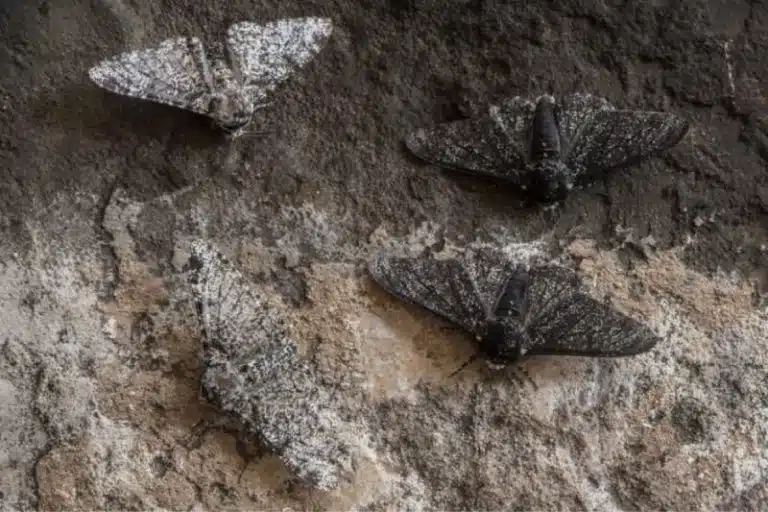
Let us look at a relatively recent example of how natural selection has caused an appearance change within a population. The peppered moth can be commonly found in Britain. Before the industrial revolution, many natural surfaces in Britain were covered in light-coloured lichens. This provided light-coloured moths with camouflage, allowing lighter-coloured moths to escape predators, survive and produce more light-coloured offspring.
However, the industrial revolution brought pollution along with technological advancements. As surfaces became darkened with soot, lighter-coloured moths no longer had the selective advantage of being able to camouflage efficiently with the surroundings and were easily spotted by predators. Instead the darker-coloured moths were now able to better camouflage with their darker surroundings, gaining the selective advantage of avoiding predators. As a result, dark moths thrived and became more prominent over light ones. In recent years, as pollution decreased, light-coloured moths have made a comeback, demonstrating how natural selection
Fig 2. An image showing a light and a dark-coloured peppered moth against different environments. The light-coloured moth is more easily camouflaged in lighter backgrounds while the darker moth is easily spotted. However, on a dark background, the lighter moth is easily spotted while the darker moth is well hidden.
Neo-Darwinism
With our modern understanding of genetics, Neo-Darwinism now focuses more on an individual’s genetic makeup rather than the selection pressure exerted by the environment. Individuals are now selected through having advantageous alleles, while those with disadvantageous alleles do not thrive. Let us take hemophilia as an example. Individuals carrying both recessive alleles and suffering from hemophilia are still less fit and have a higher mortality compared to healthy individuals. However, the environment is not necessarily putting any selection pressure against individuals with hemophilia. With Neo-Darwinism, one can only begin to wonder, to what extent is the environment still relevant to evolution? Or is our selective advantage conferred upon us purely by our genes?
Genetics as a Driver of Evolution
In this modern age, we have understood that variation in traits ultimately stems from genetics. Genetics provide the blueprint of life, and evolution is the process of life. Through mechanisms like mutations, recombination and selection genetics shape the diversity and adaptability of life over time.
Mutation
Mutations are the source of all genetic variation. New mutations can create entirely new alleles, and if these new alleles confer strong selective advantages, they could have large effects on allelic frequencies. Only mutations in gametes will be inherited, as they are the ones involved in reproduction.
Genetic Drift
Genetic drift refers to a random change in allelic frequency within a population, likely due to chance events. It can lead to great shifts in a population’s genetic variation, some alleles may be wiped out, while other previously rare alleles may become more common! Genetic drift is more impactful in smaller populations, and can occur through founder effect or the bottleneck effect.
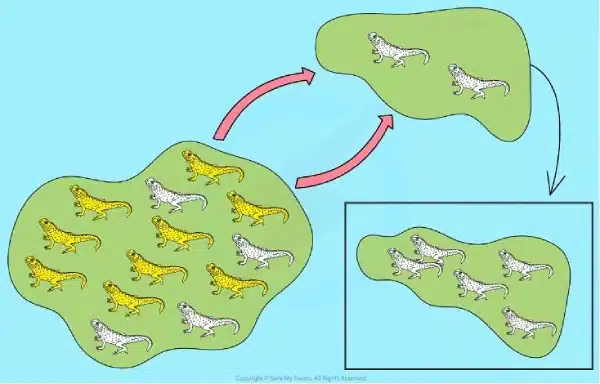
The founder effect occurs when a few individuals become isolated from the main population, and end up establishing a new population with a different gene pool from the main population’s.
Fig 3. An illustration demonstrating the founder effect. Most lizards within the main population are yellow. By a chance event, some minority white lizards end up on an isolated island where they are able to interbreed. The newly founded population now consists of only white lizards, whereas the original population is still predominantly yellow.
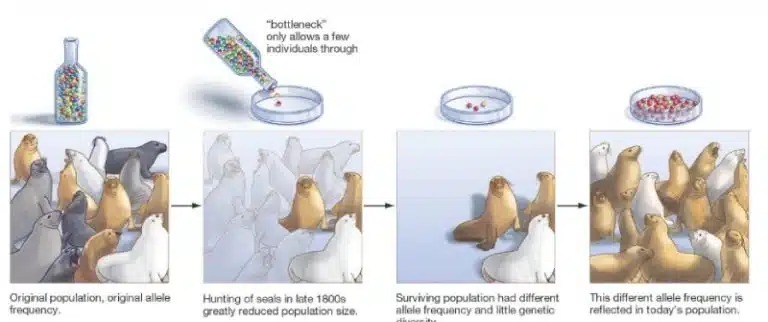
The bottleneck effect occurs when there is a sudden, drastic reduction in population size. The small number of survivors may not represent the original gene pool, resulting in overrepresentation of previously rare alleles amongst the survivors.
Fig 4. An illustration demonstrating the bottleneck effect. The coat colours of the original population were diverse. However, hunting of seals resulted in a drastic reduction in population size. Amongst the survivors which were able to live long enough to produce offspring, brown and white coat colors ended up being overrepresenting in comparison to the original population.
Gene Flow
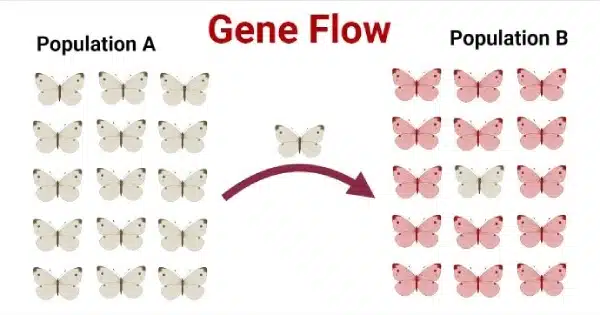
Gene flow, also known as gene migration or gene transfer, refers to the movement of genetic material between populations of a species. By introducing new alleles to another population, gene flow increases genetic variation and diversity and drives evolution. An example of gene flow can be observed simply with human migration. The advent of global travel enables people to move to new cities or countries and interbreed with the local population, leading to the spread of genes across geographical boundaries. On the other hand, reduced gene flow can result in increased isolation of populations, eventually resulting in speciation.
Fig 5. An illustration describing gene flow. The arrival of a white butterfly to a population consisting only of pink butterflies increases genetic variation within the population.
Speciation
A species is a basic unit of biological classification, where each species has its own distinct characteristics. There are various accepted definitions for what constitutes a species.
1. Biological species concept: A species refers to a group where members are able to interbreed in nature and produce viable offspring. This definition has its limitations, as it cannot be applied to asexually reproducing and extinct organisms. Additionally, this definition relies on observed mating in nature, which may be difficult to study.
2. Morphological species concept: Members of a species have a unique set of physical and structural features. The most widely used method since antiquity, as many species were recognized in olden times using physical characteristics (colour, shape of petals etc.) This definition can also be applied to asexual and extinct organisms. However, similarity in structures may not indicate evolutionary relationships (a duck and platypus have webbed feet, but are not closely related evolutionarily). Additionally, morphological differences are subjective, researchers may disagree on which morphological features distinguish a species.
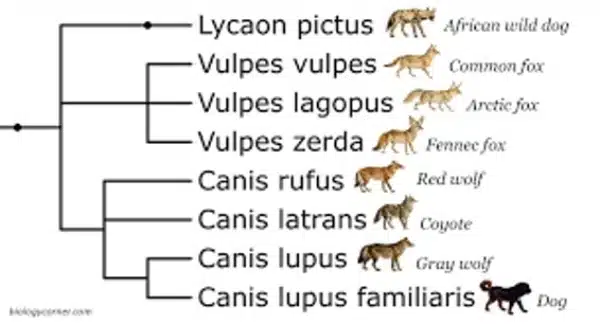
3. Phylogenetic species concept: Members of a species are the smallest set of organisms that share a common ancestor and form one branch on the tree of life. Evolutionary biologists compare morphology and molecular (DNA and protein) sequences against other species to determine evolutionary relationships with other organisms. This definition can be used on nearly any organism, as long as molecular analysis can be performed. However, the difficulty of this concept in deciding how much of a difference in sequence is required to classify a separate species.
Fig 6. A phylogenetic tree showing the phylogenetic tree of various species. From this tree, we can see that the dog and gray wolf are distinct species, but share a common ancestor.
4. Ecological species concept: Members of the same species are adapted to survive and play similar roles in an ecosystem. This concept can account for asexual organisms, but may not apply well for extinct organisms as it is difficult to identify its role in an ecosystem.
Speciation
Speciation refers to the formation of a new species, where one species diverges from another during evolution. The biological species concept is most commonly used when studying speciation, as a new species is said to be formed when a population can no longer interbreed with another closely-related population to produce fertile and viable offspring. Isolation, in particular reproductive isolation, is a key driver of speciation. When populations become isolated, they end up evolving independently which leads to differences in their genetic makeup and ultimately, distinct species.
Geographical Isolation
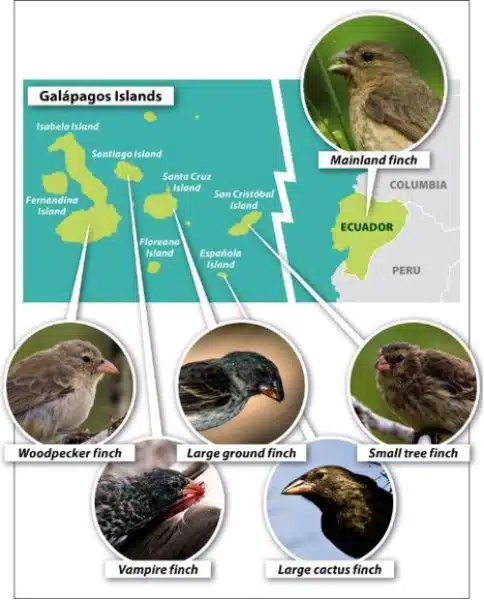
Geographical isolation refers to the separation of populations by physical barriers, such as water, mountains and valleys. This geographic barrier prevents interbreeding between separated groups, limiting gene flow. Over time, the isolated populations would experience different selective pressures, and accumulate distinct genetic traits in adaptation to these selective pressures. If these differences become significant enough, the isolated populations are no longer able to interbreed and have evolved into separate species, a process known as allopatric speciation.
Fig 7. A diagram showing the various species of finches across the Galapagos islands. The ancestral finch initially arrived from Ecuador, and its descendant species now populate the Galapagos islands. Due to the isolation of the islands, interbreeding between finch populations on different islands was not possible. Over time, the finches have evolved into distinct species to adapt to each island’s specific selective pressure.
Physiological Isolation
Physiological isolation refers to reproductive isolation resulting from differences in physiology which prevent interbreeding. Physiological isolation can occur due to mechanical isolation, where physical differences in genitalia prevent mating between species, and reproductive organ incompatibility, where the shape, size or location of reproductive organs are not compatible between species.
An example of mechanical isolation can be seen in damselflies, where the male genitalia is specialized and only compatible with females of the same species. Reproductive organ incompatibility can be observed with flowers, where structures such as the length of the nectar tube are adapted to attract specific pollinators, thus preventing cross-pollination between different species. As no geographical isolation is required, and the different species can exist in the same place while preventing interbreeding, physiological isolation is an example of sympatric speciation (where new species evolve from an ancestral population without physical barriers between them).
Behavioural Isolation
Behavioural isolation occurs when different species have different habits and behaviours that prevent them from interbreeding. Similar to physiological isolation, separate species can arise through behavioural isolation without physical barriers, and is also an example of sympatric speciation.
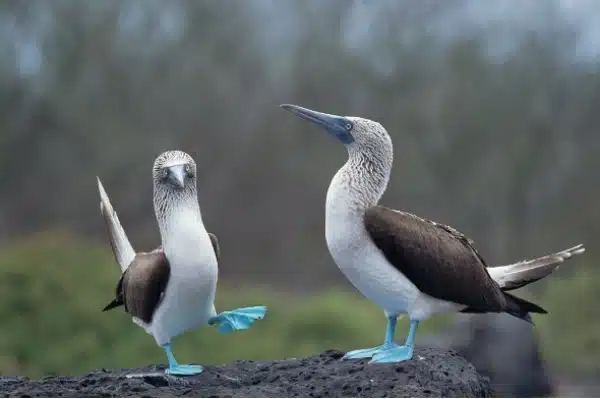
An example of behavioural isolation is that of the blue-footed booby. This bird with bright blue feet attracts potential mates by performing a dance only recognized by the same species, thus preventing attracting and interbreeding with other species.
Fig 8. A pair of blue-footed boobies.
Evidence Supporting Evolution Driving Speciation
Charles Darwin only kick started the study of evolution with the publishing of his book “On the Origin of Species” in 1859. However, evolution has been going on for millions of years before that. How are evolutionary biologists able to gather evidence of evolution? The answer lies in studying homology and similarities between different organisms.
As evolution is the process of gradually modifying existing characteristics for better adaptation, characteristics that were present in an ancestral organism would be altered in descendants over time. As a result, evolutionarily related species can have similar characteristics but different functions. Such similarity stemming from common ancestry is known as homology. The more recently two species have shared a common ancestor, the more homologies they share.
Anatomical Homology
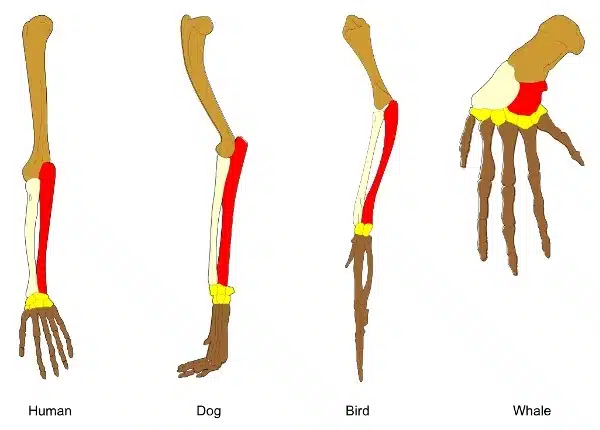
Anatomical homology refers to similarities in anatomic structure between different species due to their shared ancestry. Even though these structures now have different functions, they are thought to have been derived from a common ancestor.
Fig 9. An example of anatomical homology observed in vertebrate forelimbs. A human arm, dog’s foot, bird’s wing and whale’s flipper share the same underlying bone and reflect a common ancestry, even though these bones have now been adapted for different functions.
Molecular Homology
Mutations are an event of chance, and over time, more and more mutations occur. These mutations cause changes in DNA and protein sequence, and eventually speciation events. Hence, comparing similarities in DNA and protein sequences can help biologists study the evolutionary relationships between various species.
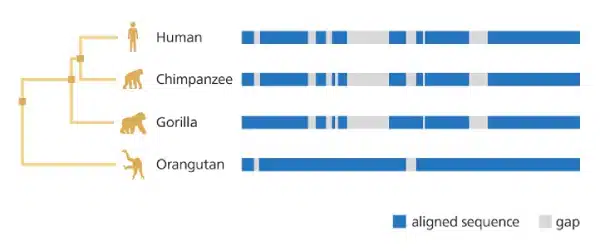
DNA homology refers to shared ancestry of genes between different species. The similarity of DNA sequences between species indicate their relatedness through evolution. More similar sequences generally suggest a closer evolutionary relationship.
Fig 10. An illustration showing the comparison of the genomes of the four great apes, along with a phylogenetic tree showing their evolutionary relationship. Humans and chimpanzees are the most closely related and have the most similarities in DNA sequence, followed by gorillas and orangutans.
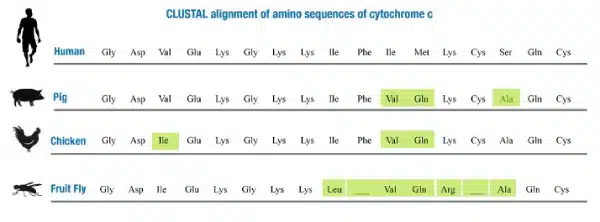
Similar to DNA sequences, similarities in protein sequences are also used to study evolutionary relationships between species. The more similarities there are, the more closely related the species.
Fig 11. An illustration showing the protein sequence alignment for cytochrome c. Based on the differences in sequences relative to the human sequence, we can conclude that our closest evolutionary relatives are pigs, followed by chickens and fruit flies.
Divergent and Convergent Evolution
By now, we should be well familiarised with the idea of natural selection, and how it drives the evolution of species that are well adapted to the selective pressure placed on them by the environment. However, we should also note that just like how species with different characteristics and adaptations can arise from a common ancestor, it is also possible for species from different common ancestors to end up having similar characteristics!
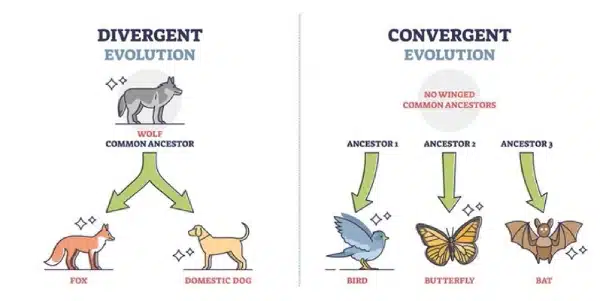
Divergent evolution occurs when species bearing different characteristics and adaptations arise from a common ancestor. On the other hand, convergent evolution occurs when unrelated species with different common ancestors evolve to have similar characteristics, in order to adapt to the selective pressure of their environment.
Fig 12. An illustration depicting the difference between divergent and convergent evolution. In the example of divergent evolution, the common ancestor (wolf) evolves into two different descendant species (fox and dog). In the example of convergent evolution, the bird, butterfly and bat share no common ancestor, but end up developing wings for flight through evolution.
Classification and Phylogeny
Now that we have understood evolution and how species arise from it, let us look into how species are organised. Biological classification is the organisation of species into groups based on shared characteristics, while phylogeny is the organisation of species based on evolutionary history and relationships.
Biological Classification
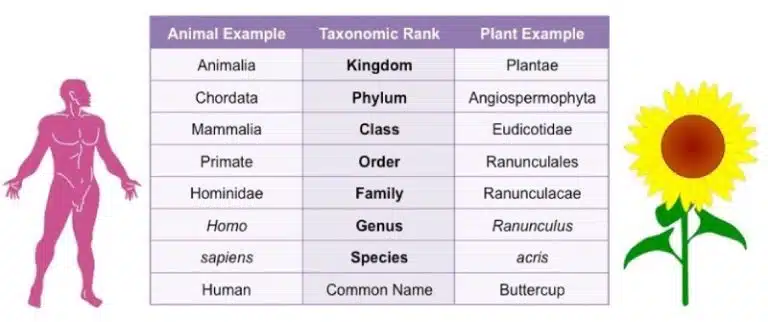
As it attempts to organise organisms based on characteristics, biological classification may not take into account evolutionary relationships. The current hierarchical classification system was first established by Carolus Linnaeus in the 16th century. This system has two main characteristics, a binomial naming system (a two-part name eg. Escherichia coli) and a hierarchical classification into broader taxonomic categories. Linnaean taxonomy places related genera (singular, genus) into the same family, families into orders, orders into classes, classes into phyla (singular, phylum), phyla into kingdoms. A popular mnemonic to remember the taxonomic ranks is King Philip Calls Out For Good Soup.
Fig 13. Examples of classification using the human (Homo sapiens) species and buttercup flower (Ranunculus acris) as examples.
Phylogeny
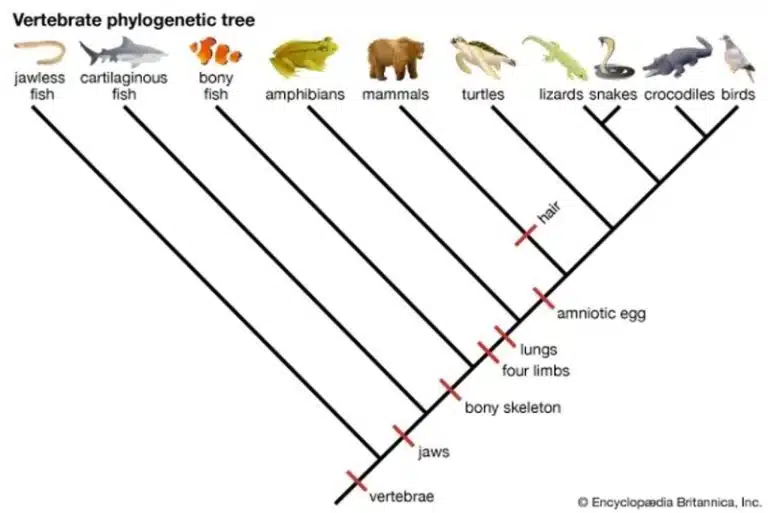
Phylogeny takes evolutionary relationships into account when organising organisms. A phylogenetic tree is used to represent organisation of species. Each branching point of a phylogenetic tree is a speciation event, and one can track the common ancestors shared, and how far back speciation events have happened! Researchers take into account anatomical and molecular homology when studying phylogeny between species. Hence, classification by phylogeny is much more intensive than by biological classification.
Fig 14. A phylogenetic tree showing the evolutionary relationships among modern vertebrates. One can tell how closely (for distantly) related each species is from each other, and the speciation event which led to the evolution of new characteristics.
Life on Earth arose when a bunch of nucleic and proteins came together and formed organisms that are able to replicate. Over millions of years, life has evolved from simple prokaryotes to the complex eukaryotes and hardy extremophiles that we see today. In the far future, even when the environment on Earth changes beyond our recognition, life will still likely find a way, as some hardy life forms triumph against natural selection and continue setting the path for evolution. In this article, we have covered the concept of evolution and its mechanisms. I hope that the readers will continue to ponder about the continuity of life, and the wonderful natural mechanisms that shape the world to be what it is today.
Find out more by joining us at Science of Studying!
You might want to download a pdf copy of this article for future reference!
Click the white download button below, enter your email, and the pdf file will be delivered to your inbox! (Remember to check spam!)
Want to improve your science results?
Discover The science of studying System!
The Science of Studying provides live online tuition via Zoom classes for Combined/Pure Chemistry, Biology, and Physics. To date, we have taught 800+ students over 12 years.
In case you are wondering, yes – there is a science behind studying!
At Science of Studying, we use our SOS system™ to teach our classes so that even last-minute students can see remarkable improvements in their grades – without mind-numbing memorisation of textbooks and without the drudgery of doing numerous assessment books.
All these conducted in a fun, interactive, stress-free online environment.
If you need help with your Chemistry, Biology, and Physics subjects, do reach out to us and we will see what we can do to help.
Join our proven online tuition programs and see real improvements in understanding, confidence, and school results. Book a free trial lesson and start the journey today or discover more below: