
Free Secondary Chemistry Notes

GCE O Level Chemistry Notes

Struggling to understand Chemistry concepts? Looking for free compiled notes on Pure Chemistry?

Explore a thorough collection of GCE O Level Chemistry revision notes, designed to help students excel in both Pure Chemistry and Combined Science exams. These free Secondary Chemistry study notes help to build a strong foundation with clear, focused explanations of key chemistry concepts and effective exam strategies.

Need more help with Chemistry? Learn more about our Online Chemistry Tuition Programme
Atomic Structure
Mole Concept
Mastering Reactivity Series
Guide to using the Periodic Table
O-Level Chemistry Practical
Functional Groups in O-Level Chemistry
Experimental Techniques
Polymerisation
Guide to Chemistry Reactions
Experimental Chemistry Questions
How to Score for Energy in O Levels
Select Subject Notes
Atomic Structure
Mole Concept
Mastering Reactivity Series
Guide to using the Periodic Table
O-Level Chemistry Practical
Functional Groups in O-Level Chemistry
Experimental Techniques
Polymerisation
Guide to Reactions
Experimental Chemistry Questions
How to Score for Energy in O Levels
Prepare for the O Level Chemistry subject

O Level Chemistry Notes

Atomic Structure

These resources will help you to review the following processes:
Structure of atom: subatomic particles (mass, charge, location)
Concept of atomic number and mass number
Electron arrangement using energy levels (e.g. 2,8,1)
Valence electrons and relation to metal/non-metal classification
Stable electronic configuration: duplet and octet rule
Concept of ions: cations, anions, and electron gain/loss
Concept of isotopes and their properties
Use of periodic table: groups, periods, and electron shell patterns
Calculate number of protons, neutrons, electrons in atoms/ions
Determine valence electrons from group number or configuration
Draw electronic and ionic structures correctly
Prepare for the O Level Chemistry subject

O Level Chemistry Notes

Mole Concept

These resources will help you to review the following processes:
Relative atomic mass, Ar
Relative molecular mass, Mr, and calculate relative molecular mass.
Mole in terms of the Avogadro constant
Calculate percentage mass of an element in a compound.
Calculate empirical and molecular formulae.
Calculate stoichiometric reacting masses and volumes of gases
Concept of solution concentration to process the results of volumetric experiments and to solve simple problems.
Calculate % yield and % purity.
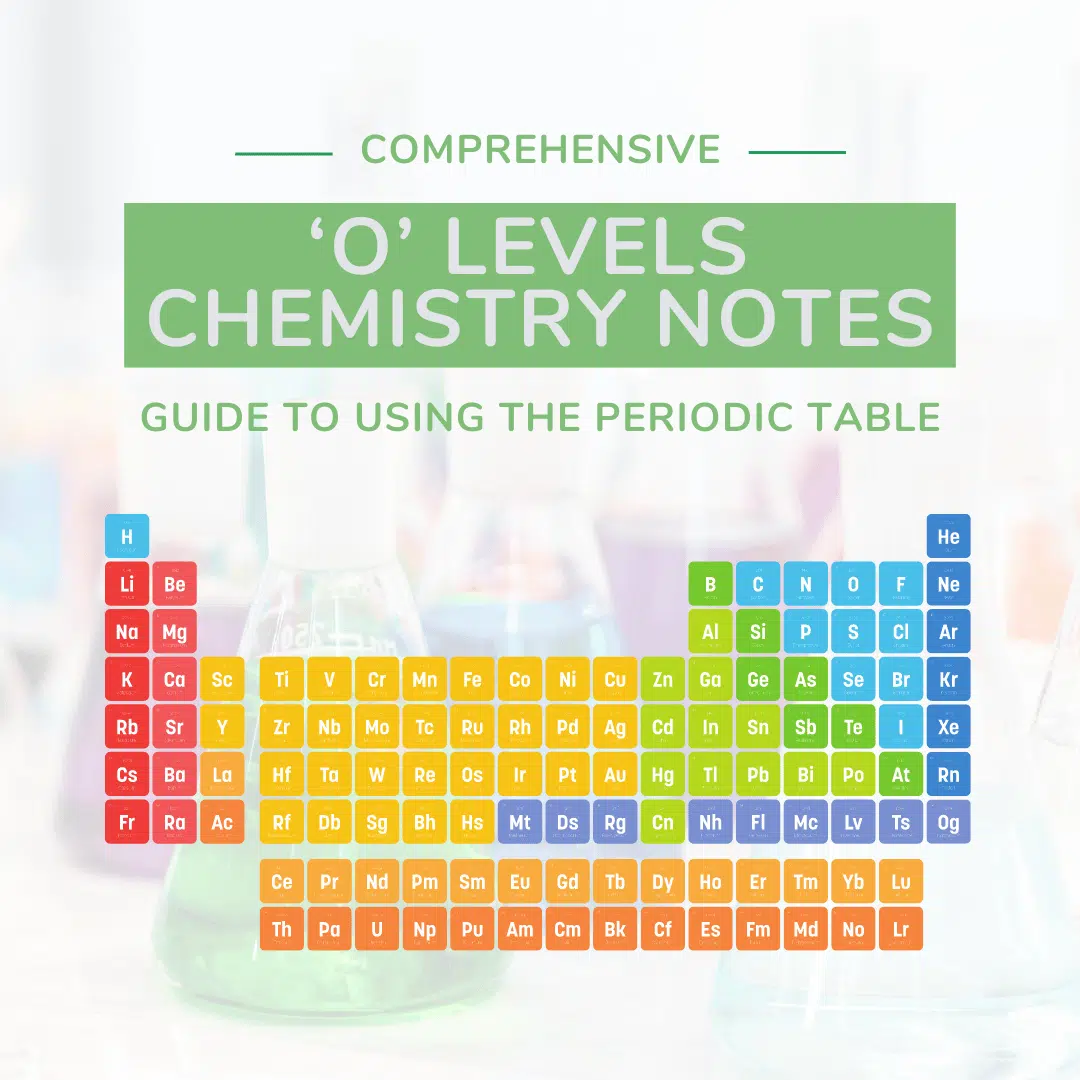
A colorful periodic table graphic with the text "Comprehensive 'O' Levels Chemistry Notes: Guide to Using the Periodic Table" over laboratory flasks in the background.

O Level Chemistry Notes

Guide to using the Periodic Table

These resources will help you to review the following processes:
Arrangement of elements by increasing atomic number; periods and groups
Concept of periods (same electron shells) and groups (same valence electrons and chemical properties)
Classes of elements: metals, metalloids, non-metals
Group 1 Alkali Metals: properties and +1 ions
Trends in Group 1: melting/boiling point ↓, density ↑, reactivity ↑
Group 17 Halogens: properties and -1 ions
Trends in Group 17: melting/boiling point ↑, reactivity ↓
Concept of halogen displacement and reactivity order (F > Cl > Br > I)
Group 18 Noble Gases: full valence shells, inert, uses
Concept of transition metals: variable oxidation states, coloured compounds, catalysts
A chemistry textbook cover showing a smoking flask with green liquid, overlaid on a periodic table background, titled "Comprehensive 'O' Levels Chemistry Notes.

O-Level Chemistry Notes

Mastering Reactivity Series

These resources will help you to review the following processes:
Reactivity series and metal reactivity order
Predict displacement reactions using the reactivity series
Reactivity of metals with cold water, steam, and acids
Trends in thermal decomposition of metal carbonates
Metal extraction based on position in reactivity series
Metals above carbon: extracted by electrolysis
Metals below carbon: extracted by reduction with carbon or hydrogen
Concept and equation of rusting (iron + water + oxygen → rust)
Methods to prevent rust: barrier, alloying, galvanising, sacrificial protection
Practical applications: corrosion prevention and metal reactivity in daily life
Prepare for the O Level Chemistry subject

O Level Chemistry Notes

Chemical Bonding

These resources will help you to review the following processes:
Ionic Bonding
Covalent Bonding
Metallic Bonding
Structures and Properties of Materials
A pipette dispenses blue liquid into a clear glass beaker, with text overlay reading “Comprehensive 'O' Levels Chemistry Notes – O-Level Chemistry Practical.”.

O-Level Chemistry Notes

Guide to Ace your O-Level Chemistry Practical

These resources will help you to review the following processes:
Understanding the format and purpose of Paper 3
Read through all instructions before starting
Highlight key steps and plan ahead
Use a rough titration to estimate the end-point
Predict observations for qualitative analysis tests
Describe observations using accurate and accepted terms
Plot graphs clearly and follow mark scheme criteria
Preparation, confidence, and calmness lead to success
Three laboratory flasks with colored liquids and molecular models are shown, overlaid with text about comprehensive 'O' Levels chemistry notes on functional groups.

O Level Chemistry Notes

Functional Groups in O-Level Chemistry Alkanes, Alkenes, Alcohols and Carboxylic Acids

These resources will help you to review the following processes:
Definition of functional groups and their role in chemical properties of organic molecules
Homologous series: general formula, functional group, and CH₂ progression
Alkanes: saturated hydrocarbons, general formula CnH₂n+2, properties and reactions
Alkenes: unsaturated hydrocarbons, general formula CnH₂n, reactivity and addition reactions
Distinguishing alkanes from alkenes using bromine water test
Alcohols: hydroxyl group (–OH), general formula CnH₂n+1OH, preparation and reactions
Carboxylic acids: carboxyl group (–COOH), general formula CnH₂n+1COOH, acidic properties and reactions
Esters and esterification: formation, naming, and applications
A pencil rests on graph paper with chemical structures, next to blue lab glassware. Text reads: "Comprehensive 'O' Levels Chemistry Notes, Breaking Down O-Level Sample Questions.

O Level Chemistry Notes

Experimental Techniques - Breaking Down O-Level Sample Questions

These resources will help you to review the following processes:
Overview of practical examinations and key components
Following instructions and experimental setup
Identifying theory and variables in experiments
Recording and quantifying observations accurately
Graphical representation of data: bar graphs and best-fit lines
Experimental planning and hypothesis testing
Biological drawings and scientific accuracy
Scientific mindset and exam success
Colorful zippers arranged in a woven pattern with text overlay: "Comprehensive 'O' Levels Chemistry Notes. Discover Polymerisation in Organic Chemistry.

O Level Chemistry Notes

Organic Chemistry: What is Polymerisation?

These resources will help you to review the following processes:
Introduction to polymers and the concept of polymerisation
Difference between monomers, polymers and repeating units
Addition polymerisation and properties of addition polymers
Uses, advantages and environmental issues of addition polymers
Condensation polymerisation and formation of polyesters
Formation and applications of polyamides such as nylon
Environmental impact of plastics and recycling methods
Biodegradable plastics and the future of sustainable polymer use
A beaker with blue liquid, molecular models, and a test tube rack in front of a chalkboard with chemistry formulas and chemical equations, promoting O Levels Chemistry Notes.

O Level Chemistry Notes

Ultimate Guide to Chemistry Reactions

These resources will help you to review the following processes:
Introduction to chemistry and equations
Predicting salts in reactions
Neutralization reactions
Acid-metal reactions
Acid-carbonate reactions
Combustion and thermal decomposition
Applications of chemical reactions in soil treatment
Importance of understanding reaction types for O-Level success
A lab table with glassware containing colorful liquids, test tubes, and bottles, under the text "O Levels Chemistry Notes: Experimental Chemistry Questions.

O Level Chemistry

Experimental Chemistry Questions

Let’s face it……Chemistry is unpredictable at the exams, especially when it comes to experimental chemistry.

There are countless experiments, reagents and methods the examiners can draw up in your paper. Therefore, it is more crucial we focus and master our fundamentals and basics and thereafter apply them to the context.

👉 Want to see how these fundamentals are tested in real exam-style questions?
Download the PDF version to access mock questions with a full answer key, so you can practise applying concepts the way examiners expect.
Cover image with text: “Comprehensive ‘O’ Levels Chemistry Notes. How to score for Energy and Functional Groups in O Levels.” Blue and red energy waves appear in the background.

O Level Chemistry

How to Score for Energy in O Levels

These resources will help you to review the following processes:

Understanding chemical energetics as energy changes in reactions
Using this guide as a structured revision and practical checklist
Fundamentals of exothermic and endothermic reactions
Common examples of energy changes in the O level syllabus
Bond breaking and bond forming as the basis of energy balance
Precision and accuracy in chemistry practical energy experiments
Planning energy experiments using the POD framework
Achieving distinction through technical rigor and scientific language

Discover How The SOS System™
Can Help Your Child Succeed

Experience a smarter way to study science with The Science of Studying. Join our proven program and see real improvements in understanding, confidence, and results. Book a free trial lesson and start the journey today.

FAQ

Frequently Asked Questions

Do you offer a free trial?

Yes, but only for the first lesson as our spaces are highly limited.

Scroll back up and click on the ‘Claim My Free Trial!’ button to register for our Free Trial Class and Consultation.

How do I pay the fees?

Tuition fees are auto-charged monthly via credit card. The renewal date for payment is every 30 days from the initial registration date.

Fees are fixed monthly regardless of the number of lessons in a month. There are no discounts for taking multiple subjects or siblings’ discounts.

No lessons will be held on public holidays, but learning materials will still be provided.

You can log in to our Parent Portal to cancel your subscription anytime. Fees charged after the renewal date will not be refunded.

Are there make-up classes or Zoom recordings if we miss lessons?

Yes, all our Zoom lessons are recorded and links to recordings will be provided.

If you miss a lesson, you can attend a make-up class within the same weekend (E.g. – If you miss lessons on Friday, make-up on Saturday).

Upon signing up, you can access Zoom recordings of all other classes to facilitate catching up.

If you are unable to attend any of the classes, you can still view the recordings.

Please note that fees will not be prorated.

What is your class size?

We can accept up to 20+ students per class in our online lessons.

What are the days and timings available for our classes?

Please refer to our Schedule.

Do you have physical classes?
All our lessons are conducted live online via Zoom, as our growing student numbers exceed the capacity of physical classrooms.
What do I need for online Zoom classes?

Please ensure you have a PC, Laptop, Tablet, or Phone with a stable internet connection to attend our lessons.

Kindly prepare your own stationery and foolscap paper for classes.

What if my child is in the IB or IP programme?

All our classes are specially curated and designed according to the GCE ‘O’ level syllabus. Hence, students in the IB or IP programmes may discover that the topics do not perfectly align with their curriculum.

However, you will still be able to learn relevant science concepts, and effective answering techniques for preparations. We also provide comprehensive resources to help your child achieve academic excellence.

How qualified are your teachers?

All our teachers are exceptionally qualified to teach the GCE ‘O’ level syllabus and graduated from prestigious local universities with valuable research experience. Their expertise allows them to teach specific exam-focused answering strategies and offer deeper conceptual insights.