
Free Secondary Biology Notes

GCE O Level Biology Notes

Access a comprehensive collection of high-quality GCE O Level Biology notes designed to support both Pure and Combined Science students. These Biology study notes cover essential concepts, exam techniques, and key content to help you confidently prepare for your exams.

Need help with Biology? Learn more about our Online Biology Tuition Programme
Movement of Substances
Enzymes
Nutrition in Humans
Select Subject Notes
Movement of Substances
Enzymes
Nutrition in Humans
O Level biology notes

O Level Biology Notes

Movement of Substances

This set of notes is suitable for students in Sec 3/4 taking Pure or Combined Biology. These resources will help you to review the following processes:
Define and compare diffusion, osmosis, and active transport
Diffusion as passive movement from high to low concentration
Osmosis as water movement through a partially permeable membrane
Identify and label hypotonic, hypertonic, and isotonic solutions
Active transport using energy to move substances against gradient
Effects of osmosis on plant and animal cells (turgidity, plasmolysis, crenation, lysis)
Common misconceptions (e.g., osmosis needing a membrane, diffusion needing energy)
Potato strip experiments and graph interpretation for water potential
O Level biology notes

O Level Biology Notes

Enzymes

This set of notes is suitable for students in Sec 3/4 taking Pure or Combined Biology. These resources will help you to review the following processes:
Biological catalysts made of proteins and their role in speeding up chemical reactions
Structure and function of the active site and enzyme-substrate complex
Enzyme specificity and the ‘lock and key’ hypothesis
Characteristics of enzymes: reused, unchanged, and catalyse reversible reactions
Factors affecting enzyme activity: temperature, pH, and substrate concentration
Effects of temperature on enzyme activity
Concept of optimum pH and how it varies for different enzymes
Regulation of enzyme production based on cellular demand
Common misconceptions about enzymes and their activity
Interpretation of enzyme activity graphs and reaction mechanisms
O Level biology notes

O Level Biology Notes

Respiration

This set of notes is suitable for students in Sec 3/4 taking Pure or Combined Biology. These resources will help you to review the following processes:
Identify the parts of the lungs and their functions in human gaseous exchange
Describe the process of breathing
Explain how the structure of an alveolus is suited for its functions
State the components of tobacco smoke and their effects on health
Define aerobic and anaerobic respiration in human cells and state the equation, in words and symbols
Explain cell respiration during intensive activities and its after effects
O Level biology notes

O Level Biology Notes

Transport in Humans

This set of notes is suitable for students in Sec 3/4 taking Pure or Combined Biology. These resources will help you to review the following processes:
Identify the main blood vessels to and from the heart, lungs, liver and kidney
Relate the structures of arteries, veins and capillaries to their functions
Describe the transfer of materials between capillaries and tissue fluid
Components of blood and their roles in transport and defence
List the different ABO blood groups and describe all possible combinations for the donor and recipient in blood transfusions
Describe the structure and function of the heart
Outline the cardiac cycle during systole and diastole
Describe coronary heart disease and list the possible causes and possible preventive measures
O Level biology notes

O Level Biology Notes

Excretion in Humans

This set of notes is suitable for students in Sec 3/4 taking Pure or Combined Biology. These resources will help you to review the following processes:
Define excretion and explain the importance of removing nitrogenous and other compounds from the body
Identify the kidneys, ureter, bladder and urethra and their functions in excretion
The function of the nephrons
Mechanism of dialysis in the case of kidney failure
O Level biology notes

O Level Biology Notes

Transport in Plants

This set of notes is suitable for students in Sec 3/4 taking Pure or Combined Biology. These resources will help you to review the following processes:
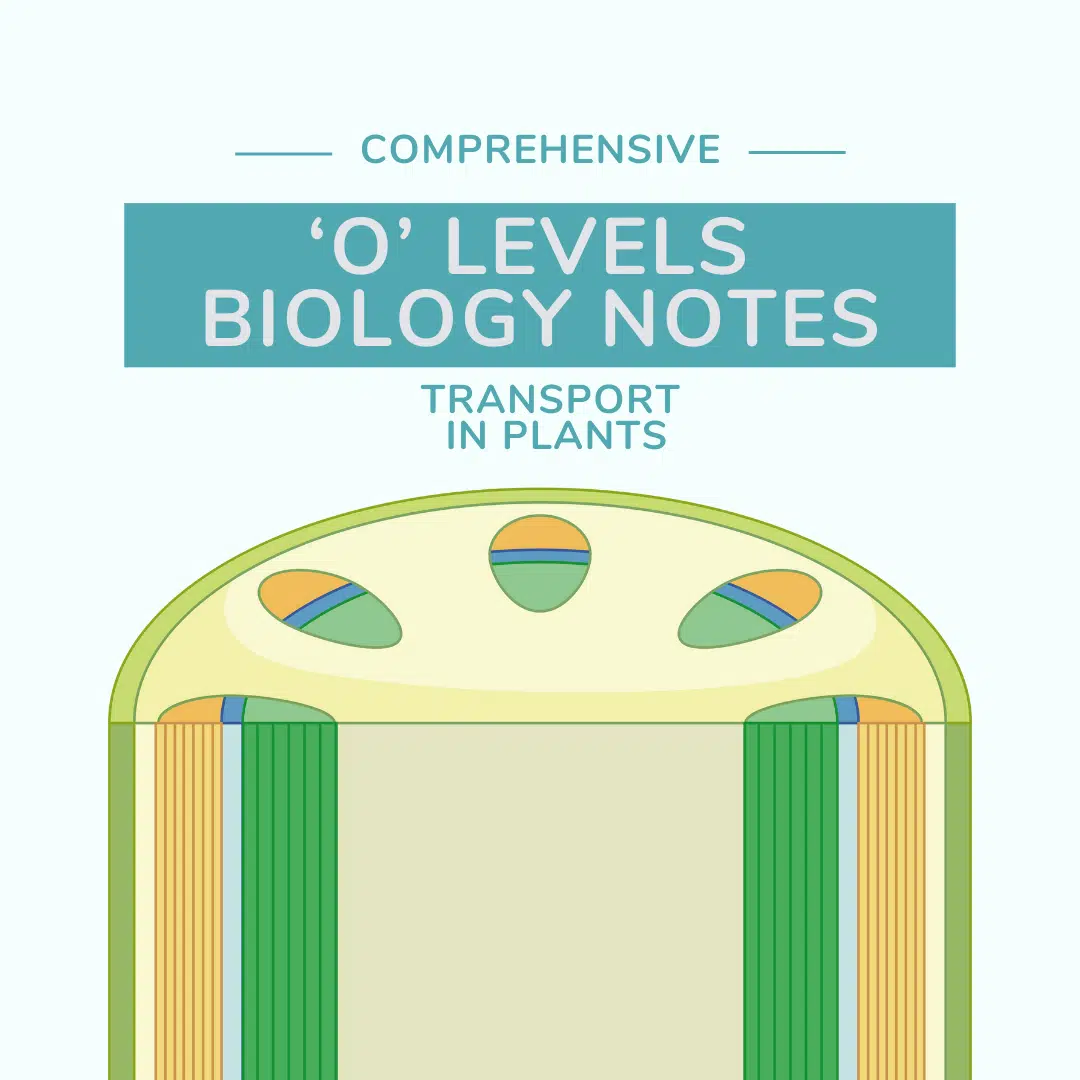
Cellular and tissue structure of a dicotyledonous leaf
Identify the positions of and explain the functions of xylem vessels and phloem of a herbaceous dicotyledonous leaf and stem.
Explain how the structure of a root hair cell is suited for its function of water and ion uptake.
Function of Chlorophyll
Explain why most forms of life are completely dependent on photosynthesis
Flat lay of various healthy foods in small bowls, including almonds, broccoli, grains, and shredded carrots, with text reading “Comprehensive ‘O’ Levels Biology Notes: Nutrition in Humans.”.

O Level Biology Notes

Nutrition in Humans

This set of notes is suitable for students in Sec 3/4 taking Pure or Combined Biology. These resources will help you to review the following processes:

The role of nutrition in human health
Autotrophic vs heterotrophic nutrition
Overview of human digestion: mechanical and chemical processes
Structure and function of the alimentary canal
Key digestive organs and enzymatic contributions
Absorption mechanisms in the small intestine
Water reabsorption and waste elimination
Digestive system as a coordinated nutrient processing network

Discover How The SOS System™
Can Help Your Child Succeed

Experience a smarter way to study science with The Science of Studying. Join our proven program and see real improvements in understanding, confidence, and results. Book a free trial lesson and start the journey today.

FAQ

Frequently Asked Questions

Do you offer a free trial?

Yes, but only for the first lesson as our spaces are highly limited.

Scroll back up and click on the ‘Claim My Free Trial!’ button to register for our Free Trial Class and Consultation.

How do I pay the fees?

Tuition fees are auto-charged monthly via credit card. The renewal date for payment is every 30 days from the initial registration date.

Fees are fixed monthly regardless of the number of lessons in a month. There are no discounts for taking multiple subjects or siblings’ discounts.

No lessons will be held on public holidays, but learning materials will still be provided.

You can log in to our Parent Portal to cancel your subscription anytime. Fees charged after the renewal date will not be refunded.

Are there make-up classes or Zoom recordings if we miss lessons?

Yes, all our Zoom lessons are recorded and links to recordings will be provided.

If you miss a lesson, you can attend a make-up class within the same weekend (E.g. – If you miss lessons on Friday, make-up on Saturday).

Upon signing up, you can access Zoom recordings of all other classes to facilitate catching up.

If you are unable to attend any of the classes, you can still view the recordings.

Please note that fees will not be prorated.

What is your class size?

We can accept up to 20+ students per class in our online lessons.

What are the days and timings available for our classes?

Please refer to our Schedule.

Do you have physical classes?
All our lessons are conducted live online via Zoom, as our growing student numbers exceed the capacity of physical classrooms.
What do I need for online Zoom classes?

Please ensure you have a PC, Laptop, Tablet, or Phone with a stable internet connection to attend our lessons.

Kindly prepare your own stationery and foolscap paper for classes.

What if my child is in the IB or IP programme?

All our classes are specially curated and designed according to the GCE ‘O’ level syllabus. Hence, students in the IB or IP programmes may discover that the topics do not perfectly align with their curriculum.

However, you will still be able to learn relevant science concepts, and effective answering techniques for preparations. We also provide comprehensive resources to help your child achieve academic excellence.

How qualified are your teachers?

All our teachers are exceptionally qualified to teach the GCE ‘O’ level syllabus and graduated from prestigious local universities with valuable research experience. Their expertise allows them to teach specific exam-focused answering strategies and offer deeper conceptual insights.