Before you read on, you might want to download this entire revision notes in PDF format to print it out for your child, or yourself to read it later.
This will be delivered to your email inbox.
Our bodies use food and nutrients to support life, health and our well-being. From food, we acquire a variety of nutrients to meet our nutritional needs, including carbohydrates, proteins, fats, vitamins, minerals and water. Carbohydrates, fats and proteins can provide the body with energy that we need to fuel our daily activities. Our bodies also use proteins and minerals to build and repair tissues for sustained growth and development. Vitamins and minerals from our foods also act as cofactors and regulators in many biochemical processes within our body, hence keeping us running like a well-oiled machine.
The study of nutrition and how food gets into our system is important for maintaining our health, preventing disease and supporting growth and development throughout our lives. In this article, we will discuss sources of nutrition, how food gets processed into biomolecules that keep us running, and the digestive system that functions to break down food into nutrients that the body can absorb and use.
Living organisms can get their nutrition through either autotrophy or heterotrophy.
Autotrophic organisms produce their own food from inorganic substances such as carbon dioxide and water. Examples of autotrophs are plants and algae, which produce glucose and oxygen from carbon dioxide and water during photosynthesis. Many species of bacteria are also autotrophs, such as sulfur-oxidising bacteria, iron bacteria and phototrophic acidobacteria, which get their energy from sulfur, iron and light respectively.
Heterotrophic organisms on the other hand rely on the consumption of other organisms for food and nutrition. Living organisms that are heterotrophic include animals which consume other organisms as food, and fungi which absorb nutrients from their surroundings. Hence, heterotrophs have specialized systems for processing the nutrients they absorb. Heterotrophs can be further classified as parasitic or saprophytic, depending on whether they obtain their nutrition from a live or dead organism respectively. Saprophytes can even be further classified into herbivores which consume plant matter, carnivores that consume animal matter, and omnivores which consume both plant and animal matter.
In this article, we will be focusing on digestion in animals. Digestion, by definition, is the process of mechanically and enzymatically breaking down food into substances for absorption into the bloodstream.
Mechanical, or physical digestion, involves the breakdown of food into smaller particles. This increases the surface area to volume ratio, allowing digestive enzymes to act more efficiently later. Mechanical digestion mostly occurs in the mouth, where you’d use your teeth to bite and chew food. The churning of the stomach also helps to break up food particles and mix them with digestive enzymes.
Enzymatic, or chemical digestion, is facilitated by digestive enzymes secreted along the digestive tract and hydrochloric acid secreted in the stomach. Physical digestion helps to break up large food particles and increase the surface area to volume ratio, which allows for more efficient breakdown of food particles into molecules that are small enough to be easily absorbed into the bloodstream.
The alimentary canal, also known as the gastrointestinal (GI) or digestive tract, is a continuous, hollow tube extending from the mouth to the anus. Digestion and absorption of food occurs along the alimentary canal, as well as the elimination of waste. The alimentary canal includes the mouth, pharynx, oesophagus, stomach, small intestine and large intestine. The alimentary canal is also associated with accessory organs like the liver, gallbladder and pancreas, which are not part of the alimentary canal itself but crucial for digestion, as they secrete fluids into the digestive tract.
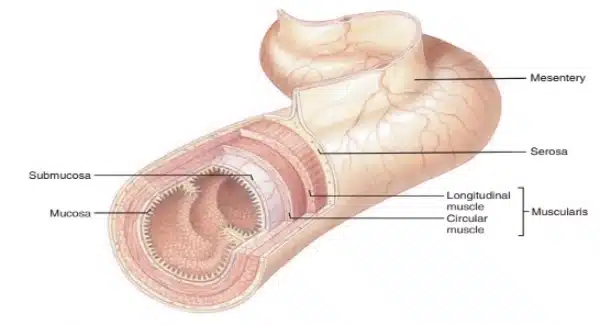
The walls of the alimentary canal comprise four layers, namely (from outermost to innermost) the serosa, muscular layer, submucosa and the mucosa. The serosa is the tough lining on the outermost wall of the alimentary canal, below which lies the muscular layer.
The muscular layer comprises two layers of muscles, namely the circular muscles on the inner side and the longitudinal muscles on the outer side. These two muscle layers contract antagonistically, resulting in a rhythmic, wave-like contraction of the alimentary canal known as peristalsis. Peristalsis is important for moving food along the alimentary canal and mixing food up with digestive enzymes.
The submucosa lies under the muscular layer, and contains the blood supply and nerve fibers which line the entire alimentary canal. Finally, the innermost mucosa layer lies under the submucosa, and is primarily responsible for the absorption of food from the alimentary canal, and the secretion of mucus, enzymes and hormones into the alimentary canal.
The organs of the digestive system function together to break down food into smaller molecules that can be absorbed easily by the body. The digestive system organs are also connected along the alimentary canal.
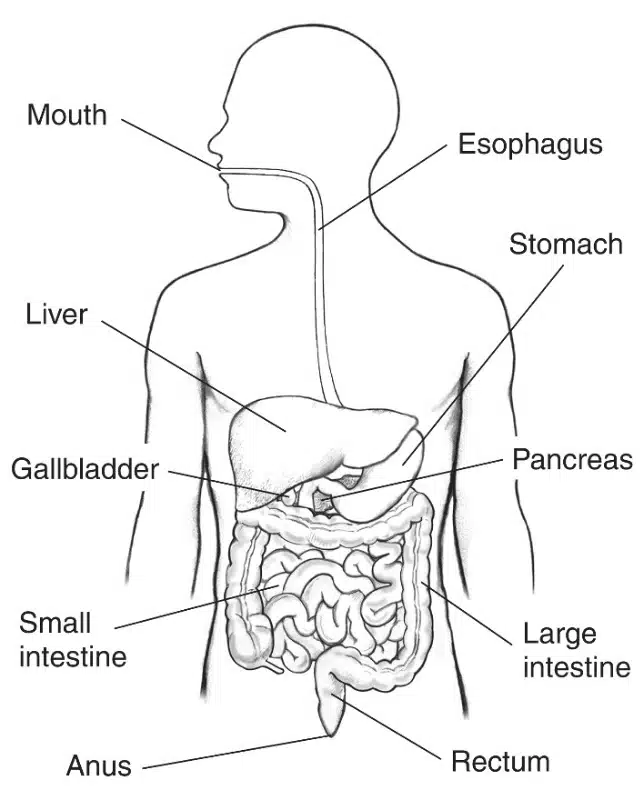
Food first enters the digestive system through the mouth. Both physical and chemical digestion takes place in the mouth, where teeth grind food into smaller particles and the enzyme amylase in saliva digests starch into maltose. Saliva also contains lysozyme, which helps to eliminate pathogens. After chewing, food is rolled into a bolus (ball) and pushed back into the pharynx (voice box) to enter the oesophagus. The epiglottis, a small flap located behind the tongue and in front of the pharynx, closes over the trachea to prevent food from entering and causing a choking incident.
The esophagus (or gullet, sometimes even spelled oesophagus) connects the mouth to the stomach. No digestion occurs here, as food is pushed towards the stomach through peristalsis. The esophageal sphincters are a pair of muscular rings that control the flow of foods and liquids through the esophagus. The upper esophageal sphincter, located at the top of the esophagus, prevents air from entering the esophagus and the reflux of food back up towards the pharynx. The lower esophageal sphincter at the bottom of the esophagus prevents stomach acids and digestive juices from flowing back up into the esophagus.
The innermost lining of the stomach (mucosa) is lined with many glands that secrete gastric juice. This gastric juice is a combination of enzymes and acids that facilitate chemical digestion of foods, and consist of:
1. Mucus
Mucus is secreted by goblet cells and helps to protect the stomach lining, preventing the stomach from digesting itself.
2. Pepsinogen
Pepsinogen is produced as a proenzyme and is converted into active pepsin in the presence of hydrochloric acid in the stomach. Pepsin is a protease that degrades proteins into smaller peptide fragments
3. Hydrochloric acid
Hydrochloric acid is produced by parietal cells in the stomach, which lowers the pH within the stomach. In addition to activating the protease pepsin (as explained earlier), HCl also provides an acidic environment that allows digestive enzymes to work most efficiently, inactivates salivary enzymes through denaturation and kills potentially harmful microorganisms in food.
The presence of food in the stomach stimulates the production of gastric juice, kick starting digestion within the stomach. Peristalsis in the stomach works to churn food, mixing it with gastric juice to facilitate digestion. Digestion in the stomach lasts for approximately 3 to 4 hours, producing partially digested food known as chyme. The chyme is slowly passed into the small intestine in small amounts through the opening of the pyloric sphincter to complete the process of digestion.
The small intestine is approximately 6 meters long, and consists of (from closest to the stomach to the furthest) the duodenum, jejunum and ileum. The mucosa of the small intestine is lined with microscopic finger-like protrusions called villi, and each villus consists of even more microvilli! These structures increase the surface area of the small intestine to facilitate digestion and absorption.
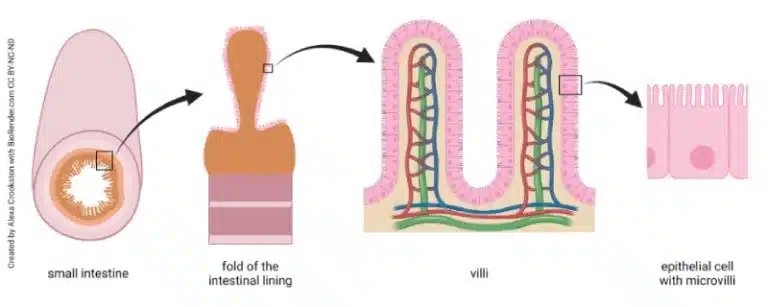
The small intestine also contains glands that secrete a variety of enzymes that help with the digestion of foods. Some enzymes secreted by the small intestine include enterokinase, maltase, lactase, suitcase, erepsin and intestinal lipase. The small intestine is also the site where fats begin to be digested, whereas the digestion of carbohydrates and proteins have already begun at earlier steps of digestion in the mouth and stomach respectively.
The liver and pancreas are accessory organs that produce bile salts and pancreatic enzymes to support digestion in the small intestine. Bile is produced in the liver and stored in the gallbladder, and contains bile salts that help emulsify fats. This breaks up globules of fats and increases surface area, allowing for more effective digestion by lipases secreted by the intestine and pancreas into fatty acids and glycerol. Bile from the gallbladder makes its way to the duodenum through the cystic duct, common bile duct and then the pancreatic duct before reaching the duodenum.
The pancreas secretes a mix of enzymes, including pancreatic amylase, pancreatic lipase and trypsin. These enzymes reach the duodenum through the pancreatic duct. The combination of intestinal juices, bile and pancreatic juices are alkaline to neutralize the acidic chyme coming from the stomach.
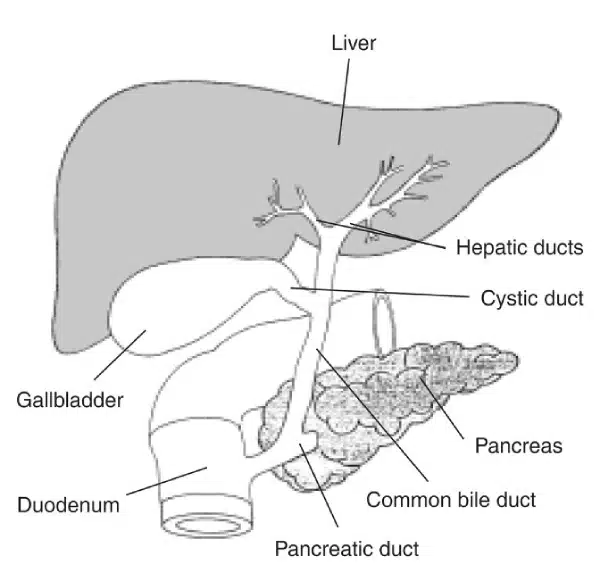
As food passes from the duodenum to the jejunum, it gets progressively digested. By the time food reaches the ileum, it would have been completely digested. Hence, absorption of nutrients from food is the main event occurring at the jejunum and ileum. Villi and microvilli that line the intestinal mucosa facilitate the absorption of nutrients.
Sugar, amino acids and mineral salts are absorbed into the bloodstream through blood capillaries in villi, either through diffusion or active transport. Glycerol and fatty acids are absorbed into the lymphatic capillaries in the villi through diffusion. Villi are richly supplied with blood and lymphatic capillaries, allowing absorbed nutrients to be swiftly carried away to the rest of the body. This maintains a concentration gradient which facilitates diffusion of nutrients from the small intestinal lumen into the capillaries within the villi.
The large intestine is a muscular tube consisting of the colon and the rectum. In the colon, water and mineral salts are absorbed from remaining undigested foods and no further digestion occurs here. The end product of this process are faeces, which are stored in the rectum. Faeces then exit the body through the anus. The opening of the anus is controlled by a pair of anal sphincters, both which have to be relaxed in order for the anus to open and allow passage of faeces.
The internal anal sphincter is primarily responsible for maintaining resting anal tone and keeping the anal canal closed to prevent leakage. It is under involuntary control, and automatically tightens and relaxes. Meanwhile, the external anal sphincter is under voluntary control and helps maintain continence, especially in situations that require control over continence.
In this article, we have gone through how living beings obtain their nutrition either through autotrophy or heterotrophy. We have also analyzed the human digestive system and discussed how food is digested and processed into molecules that can be absorbed into our bloodstream. Food and nutrition keep us alive and supplement us with energy, so it’d be best to be well-acquainted with the art and science of nutrition so that you can live your healthiest life!
Find out more by joining us at Science of Studying!
Prepared by: Michelle
You might want to download a pdf copy of this article for future reference!
Click the white download button below, enter your email, and the pdf file will be delivered to your inbox! (Remember to check spam!)
The Science of Studying provides live online tuition via Zoom classes for Combined/Pure Chemistry, Biology, and Physics. To date, we have taught 800+ students over 12 years.
In case you are wondering, yes – there is a science behind studying!
At Science of Studying, we use our SOS system™ to teach our classes so that even last-minute students can see remarkable improvements in their grades – without mind-numbing memorisation of textbooks and without the drudgery of doing numerous assessment books.
All these conducted in a fun, interactive, stress-free online environment.
If you need help with your Chemistry, Biology, and Physics subjects, do reach out to us and we will see what we can do to help.
Contact Us: Click Here
Admin number: +65 88082348

The SOS system™️ guides students through an effective process of:
Join our proven online tuition programs and see real improvements in understanding, confidence, and school results.
Book a free trial lesson and start the journey today or discover more below:
WhatsApp us