Before you read on, you might want to download this entire revision notes in PDF format to print it out for your child, or yourself to read it later.
This will be delivered to your email inbox.
Our body is made of trillions of cells, and (nearly) every cell is specialised to do a specific job. For example, our cardiac muscle cells are long and branched, allowing for a network-like arrangement, facilitating rapid and coordinated contraction in multiple directions. To power the heart’s constant beating, cardiac muscle cells also come with abundant mitochondria to ensure that there’ll always be enough energy. Meanwhile, nerve cells have long axons and branching dendrites to facilitate communication and transmit electrical signals along the nervous system.
However, we were but a simple ball of cells arising from a fertilised egg cell. How did each zygotic cell give rise to the hundreds of different cell types that make us up? In this article, we will be talking all about stem cells, and how they can be used in medicine and research.
As we have previously learned, our regular somatic cells will eventually undergo senescence when their telomeres reach a critically short length. Somatic cells are also specialized and are no longer able to differentiate into other cell types.
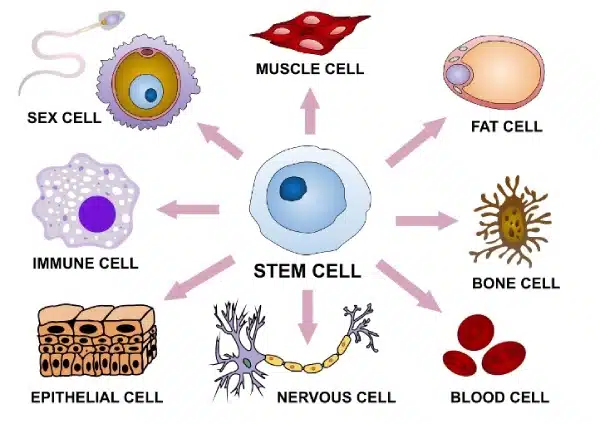
On the other hand, stem cells are unspecialised cells, capable of continuous self-renewal and have the potential to differentiate into other cell types. These properties are fundamental to stem cell function and enable them to maintain a healthy cell count , so as to maintain and repair tissues.
Being unspecialized, stem cells do not have any tissue-specific features or functions, as they have yet to “decide” what kind of cell they would become. During differentiation, unspecialized stem cells undergo epigenetic changes, allowing certain genes to be expressed while repressing others, hence giving rise to specialized cells. Once a cell becomes specialized, it is a somatic cell with very limited capacity to produce new cells. These newly specialized cells are produced throughout our lifetime to repair or replace damaged and diseased cells in our body.
The specifics about the specialization process is still not well studied and scientists are working on understanding cell signalling phenomena that trigger stem cell differentiation.
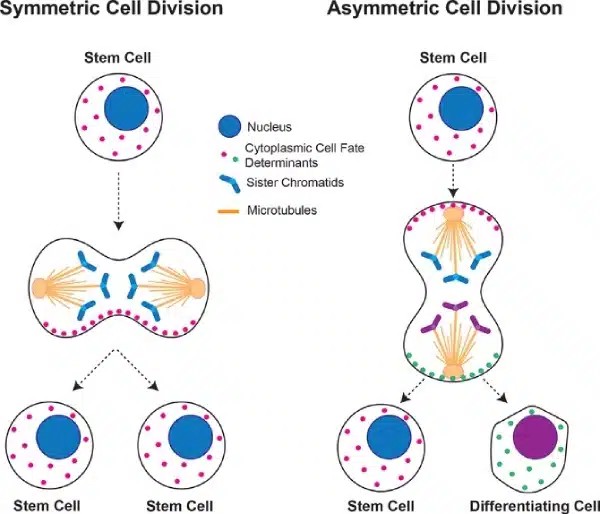
Stem cells are also capable of long-term self renewal through mitosis. Unlike somatic cells, stem cells are capable of dividing indefinitely, then allowing for a constant pool of stem cells. Stem cells can divide either symmetrically or asymmetrically. Symmetric division occurs when a stem cell divides to give rise to two identical daughter stem cells, while asymmetric division occurs when one daughter cell differentiates into a specialized cell type while the other remains as an unspecialized stem cell. Both paths of cell division ensure that the pool of stem cells is constantly replenished, allowing for a steady supply of specialized cells. Self-renewal of stem cells is vital for maintaining healthy tissues and organs under normal conditions and for repairing damage caused by injury or disease.
From having the most to least potential for differentiation, the various types of stem cells are:
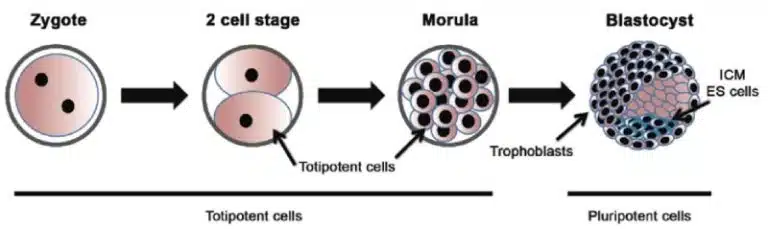
The zygote is the first diploid cell of a new organism, formed when a sperm fertilizes an egg. The zygote would undergo cell division to produce more cells and eventually reach the morula stage within a few days post-fertilization. Up till this point, all cells that arise from the zygote are totipotent, and can differentiate into any cell type, including extra-embryonic structures like the placenta.
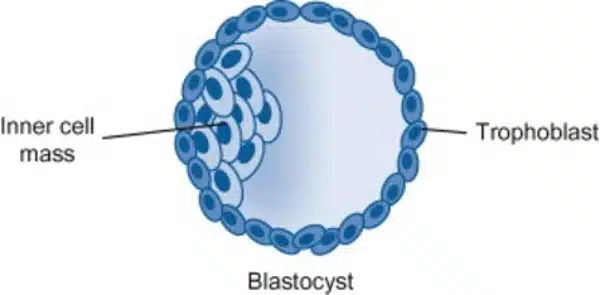
The morula transitions into a blastocyst when a fluid-filled cavity, the blastocoel, develops within it. At this stage, the blastocyst consists of the trophoblast, which will develop into extra-embryonic structures like the placenta, and the inner cell mass (ICM) which will develop into the embryo. The ICM is composed of embryonic stem cells (ES cells) which are pluripotent and can give rise to any cell and organ within the embryo (anything but the placenta and stuff outside the embryo during fetal development!).
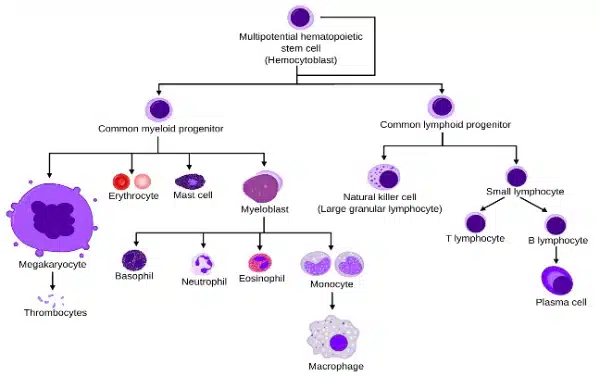
Multipotent stem cells can develop into multiple, but limited types of specialized cells, usually within an already differentiated tissue. The main function of multipotent stem cells is to maintain a healthy stock of stem cells, and to replace and repair damaged cells over the course of one’s lifetime.
Some examples of multipotent stem cells include hematopoietic stem cells (differentiate into various blood cells), mesenchymal stem cells (differentiate into bone, cartilage and fat cells) and neural stem cells (differentiate into neurons, astrocytes and oligodendrocytes). Some tissues are “hotspots” for stem cells, such as the bone marrow and umbilical cord, which are rich in hematopoietic stem cells.
Stem cells are full of potential (haha get it -potencies), and scientists are constantly on the hunt for their next big breakthrough! These days, stem cells are quite the workhorse both in research and in medicine, due to their unique properties, making them rather powerful tools for understanding fundamental biological processes.
In 2006, Shinya Yamanaka demonstrated the conversion of somatic cells into pluripotent cells, by introducing the genes myc, oct3/4, sox2 and klf4 (collectively called the Yamanaka factors). Since these cells were induced into a pluripotent state, they were termed induced pluripotent stem cells (iPSCs). For his pioneering work on iPSCs, Yamanaka was awarded the 2012 Nobel Prize.
iPSCs have huge applications in research and medicine, mostly due to the fact that they are derived from adult somatic cells. This bypasses the need to obtain embryonic stem cells from embryos, which was a huge ethical concern. iPSCs also offer the possibility for personalised therapy, as one’s somatic cells can be turned into iPSCs, enabling tailored treatments based on one’s unique genetic makeup.
As previously mentioned, there is still much to learn about how stem cells specialise into tissues and organs. The field of developmental biology heavily studies stem cells to answer how we came to be from our stem cells? Stem cells can also be induced to differentiate into tissues in the lab, providing researchers with plenty of material to study disease mechanisms without requiring human sacrifices. New drugs are also tested on lab-grown human cells derived from stem cells, allowing scientists to check for safety and efficacy before subjecting actual humans to the drug during clinical trials.
Perhaps you have heard of cord blood banking, where umbilical cord blood is stored after a baby’s birth (for a price ofc). This precious cord blood is rich in hematopoietic stem cells, and can be used for treating various diseases, particularly those affecting the blood and immune system. Not only can this cord blood save the child’s life in the future, if there is a match, it may even be used for siblings and other family members.
A commonly known therapeutic usage of stem cells would be a bone marrow transplant, used to treat blood cancers like leukemia. The stem cells from a donor bone marrow are harvested and infused into the patient, allowing the new healthy stem cells to re-establish a supply of healthy blood cells. A bone marrow transplant can be autologous (using your own cells, see previous paragraph on cord blood banking) or allogeneic (cells from a donor).
Stem cell research is a rapidly growing field, and in the future, we’d likely have much more stem-cell based therapeutic options!
With many glorious scientific achievements, there are always ethical considerations to look into. For example, even though iPSCs offer a more humane source for pluripotent stem cells, one still has to consider informed consent from donors of embryos, tissues and cells. As stem cell research continues to progress by leaps and bounds, there are concerns about commercial exploitation, privacy and unintended future uses of donated biological materials.
Stem cell therapies, even with much advancements being made, are still extremely expensive. This has led to concerns about the equity of healthcare, and whether only the rich are able to access ground-breaking and life-saving treatments. Additionally, there are concerns about the safety of clinical trials involving stem cell therapy, since many treatments are still within their infancy. The boundless potential of stem cell research may also drive ethically questionable research objectives. For example, it is definitely possible to perform genetic engineering on stem cells, which can open the door for “unnatural and extensive” modifications made to our cells.
In this article, we have covered the topic of stem cells and their vast potential in research and medicine. While the field is still evolving, new discoveries and insights are constantly emerging. One thing is for certain though, just like how stem cells transform into many specialised cell types, the field of stem cell research will continue to grow, adapt and reach new heights in the coming years.
Find out more by joining us at Science of Studying!
Prepared by: Michelle
You might want to download a pdf copy of this article for future reference!
Click the white download button below, enter your email, and the pdf file will be delivered to your inbox! (Remember to check spam!)
The Science of Studying provides live online tuition via Zoom classes for Combined/Pure Chemistry, Biology, and Physics. To date, we have taught 800+ students over 12 years.
In case you are wondering, yes – there is a science behind studying!
At Science of Studying, we use our SOS system™ to teach our classes so that even last-minute students can see remarkable improvements in their grades – without mind-numbing memorisation of textbooks and without the drudgery of doing numerous assessment books.
All these conducted in a fun, interactive, stress-free online environment.
If you need help with your Chemistry, Biology, and Physics subjects, do reach out to us and we will see what we can do to help.
Contact Us: Click Here
Admin number: +65 88082348

The SOS system™️ guides students through an effective process of:
Join our proven online tuition programs and see real improvements in understanding, confidence, and school results.
Book a free trial lesson and start the journey today or discover more below:
WhatsApp us