
The start of a new school year always stirs up a sense of excitement and anticipation. Some of us are starting a fresh new chapter, with a new school, new people and a new learning system to get used to. Some of us are coming back to the same classrooms, but with new challenges and a new set of expectations as we get another year closer to the big ‘A’-Level exam. Regardless of what year of study you are in, or how you did in school in the previous year, there’s never a better time to review your study habits and build more effective habits than right now.
When we want to make a big change in our lives, oftentimes we set huge goals and try to motivate ourselves into achieving them – but this is unsustainable if we want to make lasting change. In his bestselling book Atomic Habits, James Clear writes of the compounding power of making tiny but continuous improvements to habits over time, and advises us to focus on our processes rather than our goals. He writes, “You do not rise to the level of your goals. You fall to the level of your systems.”
Here are five small changes you can start making to your study routine that will eventually compound by the end of the year:
1. Review your lecture notes within 24 hours of learning the topic
I know – the last thing you feel like doing after a long lecture for a new topic, when your brain is still reeling from so much new information, is to go back and look at the same lecture notes again. However, it turns out that we forget about 50% of new information within 24 hours of learning it, and will have forgotten 90% of it by the time one week has passed.
This has been documented since 1885, when Hermann Ebbinghaus published a “forgetting curve” based on his studies of his own retention ability. His findings have since been replicated in other studies by neuroscientists.
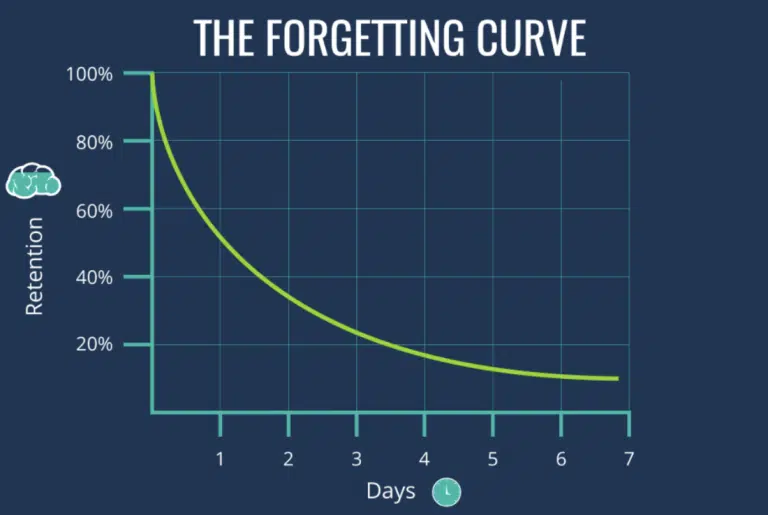
Ebbinghaus’ Forgetting Curve (image credit: eLearning Industry)
The best way to combat the forgetting curve is to interrupt the process by revisiting the material at specific time intervals just as you’re about to forget it – a technique called spaced repetition. The great thing about spaced repetition is that after every review session, the brain retains the new information a little bit better, and the rate of forgetting gets slower. This allows us to gradually increase the length of time between review sessions and commit what we learn to long term memory.
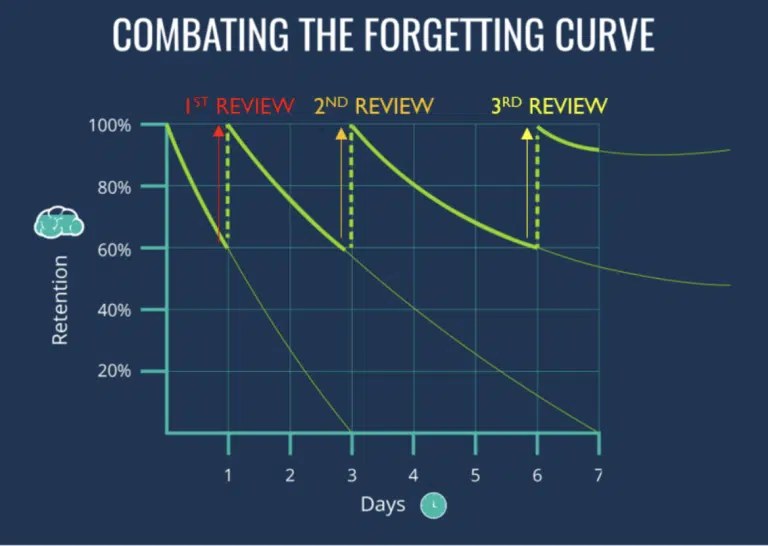
Spaced Repetition and the Forgetting Curve (adapted from: eLearning Industry)
Try this: After each lecture, use a planner or your phone calendar to set a reminder to review your lecture notes: 1) the same night, 2) two or three days after that, 3) a week after that, and set a specific time and place each day to do it.
It’s alright if you don’t understand all the material at once – the idea is to give yourself time to revisit the material while it is still fairly fresh in your mind, and make connections that you may have missed the first time around. And while it’s really tempting to just flip through your notes wherever and whenever you have time, having a fixed location and time to do it creates a clear cue for your habit, which helps switch your brain into ‘study’ mode and makes it easier to maintain consistency: the single most important factor in building a new habit.
2. Copy worked solutions – but only from memory
Anyone who has spent a little time in a bookstore can tell you that worked solutions are a huge selling point for assessment books, since they give a step-by-step guide to getting the answers. You’ve probably also experienced that ‘Eureka!’ moment sitting in lecture or tutorial, staring at a question you don’t know how to even tackle, when finally the teacher or maybe one of your classmates shows you the steps to solve it, and suddenly it seems so obvious and easy.
While seeing the worked solutions can give you a lot of insight in the moment, remembering them at a later date is a different story entirely. This is because reading the solutions is a form of passive recall, which involves passively reviewing study materials. When many of us study, we often turn to passive recall techniques, which include reading, highlighting, summarizing, watching, or listening to content, since they make us feel productive for relatively little effort. However, although your brain recognizes the information, it is not practicing to fetch any information from memory, making passive recall much less effective for the time it takes.
By contrast, active recall is a study technique where you deliberately test yourself to retrieve information from your memory banks. Common active recall techniques include using flashcards, doing practice questions, and even re-teaching the material to someone else. While it takes some more effort compared to passive recall, every time you actively recall something from memory, you are not only reorganizing and consolidating your knowledge to make it easier for your brain to process, you are also strengthening your neural pathways and making the information faster to access in the future.

Do you learn a song faster by just reading sheet music, or by playing it from memory?
We can use active recall techniques to engage more meaningfully with study materials normally associated with passive recall, such as answer keys and worked solutions. The trick is to not just read through and understand the answers, but also to test ourselves to recall what we have learnt without cues – by covering up the solution and rewriting the answer in response to the same question.
For subjects with a heavy calculation component, such as Mathematics, Physics and Chemistry, doing this with worked solutions also has the added benefit of training your brain to reorganise and engage with the problem-solving procedure, helping you better understand how to do similar calculations, and why the steps need to be taken in a certain order.
Try this: When looking at the solution to a tutorial question, or reading through worked solutions in an assessment book, take about 3-5 minutes to read through it. Then, cover up the solution and without referring to it, use the same method you just learned to solve the same question again. This forces your brain to practice active recall and trains the neural connections that links up the relevant information, making it stronger and hence even easier to access.
3. Build a memory palace to remember long lists of information
Many subjects such as Biology, History, English Literature among others require you to remember long lists, sequences and even whole chunks of text. To make memorization a little easier and more fun, we can borrow a trick used by the ancient Romans, Sherlock Holmes and memory champions who can recite thousands of digits of pi: building a memory palace.
The memory palace, or method of loci, exploits two quirks of human memory: we remember things more easily when we know where they are (spatial information), and we remember images more easily than words (picture superiority effect). The “memory palace” itself can be any familiar spatial environment, like your home, your school or even the route you take from home to your nearest MRT station.
To build your memory palace for a list of things, you’ll need to 1) visualize a route through a location that you know very well, 2) imagine each item on the list as a vivid and memorable image (the more absurd, crazy and weird, the better), then 3) place each image at set points along your imaginary route. Then, to remember the list, you’ll follow the same route over and over again.
Let’s try it with an example: perhaps you need remember the steps of the Calvin cycle for Biology:
- CO2 is fixed and combined with RuBP.
- The enzyme RuBisCO is responsible for this change.
- The resulting intermediate is unstable and splits into two PGA molecules.
- The PGA molecules are phosporylated by ATP into bisphosphoglycerate.
- Bisphosphoglycerate is reduced by NADPH into glyceraldehyde-3-phosphate, or triose phosphate (TP).
- 6 turns of the Calvin cycle produces 1 glucose molecule from two TP.
The remaining TP regenerates RuBP to start the cycle again.
Now imagine your morning routine, and the route that you would take in your house after waking up each morning. For example, let’s say that every morning, you switch off your alarm clock, go to the bathroom to brush your teeth, check yourself in the mirror, and spit into the sink. You then head to the kitchen to get some breakfast and sit at the dining table to eat it.
As you picture yourself walking through your house along this route, imagine this series of events happening:
You wake up to your alarm clock ringing, but when you go to switch it off, you find Calvin from Calvin and Hobbes yelling at you (and exhaling a lot of CO2). Your alarm clock was broken, so he fixed it for you.
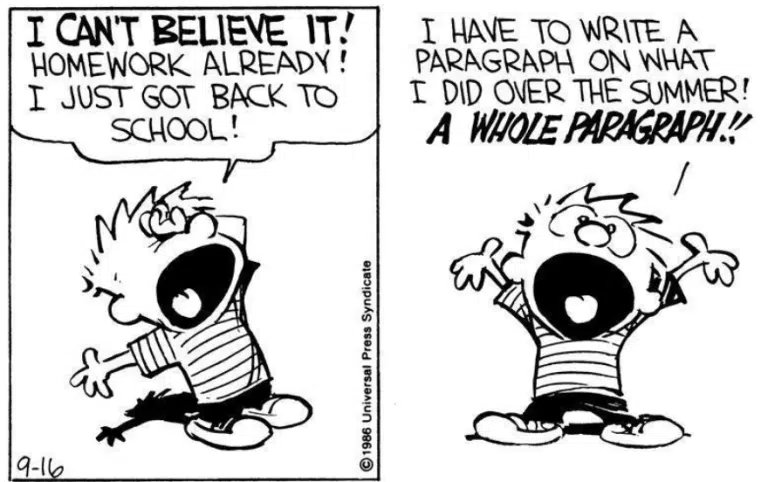
Calvin is a mood.
You head to the bathroom and when you see yourself in the mirror, you see a huge red ruby (RuBP) stuck on your forehead. When you take the ruby off and blow at it, it inflates into a disco ball (RuBisCO). The disco ball splits in half, and out fall two pigs (PGA) into your sink. You walk to your kitchen to get some breakfast, where you see the two pigs drinking energy drinks (ATP, the store of energy) and pooping out biscuits (bisphosphoglycerate). You grab some lemonade, piping hot (NADPH) and sit down at the dining table with your breakfast. Now you find Calvin running around your table with two rolls of toilet paper (triose phosphate, TP) in his hands. He runs around 6 times, throwing rolls and rolls of toilet paper all over the floor. You grab the toilet paper rolls from his hands, but they suddenly crumble into sugar (glucose). And when you look down, the floor below is covered in rubies (RuBP).
Sounds ridiculous, doesn’t it? But remember, the more crazy and bizarre the image, the easier it sticks in your mind, and the clearer you can remember the whole sequence! You can even add sounds, smells and other sensations to make the image even more vivid and memorable.
Try this: Pay a little more attention to places you encounter often, and identify set points and landmarks that you can use for your memory palace. Then, every time you have a list to memorize, start thinking up bold and wild images associated with them, and place them along your mental route through the memory palace. Think of your images and where they are each time you pass through the location, and soon you’ll be able to remember them just by visualising the place in your mind.
4. Start studying for only two minutes
Many people find it difficult to focus on one activity for even an hour, and for good reason – most young adults can only focus on one object for about 70 seconds before getting distracted or needing to refocus their attention. With social media feeds and endless content constantly vying for our attention, sitting down to study for an hour feels like an insurmountable task that we’d rather do ‘later’ (translation: never) – and when we actually try doing it, we oftentimes get sidetracked by a funny message in the group chat or a reminder to complete our dailies in a game (you know who you are!)
To get over procrastination, James Clear proposes the Two-Minute Rule: when you start a new habit, it should take less that two minutes to do. It turns out that almost any habit or task can be condensed into a two-minute version: “exercise for an hour” becomes “put on my workout clothes”, “write an essay” becomes “write one sentence”, and “study for an hour” becomes “sit down and open my notes”.
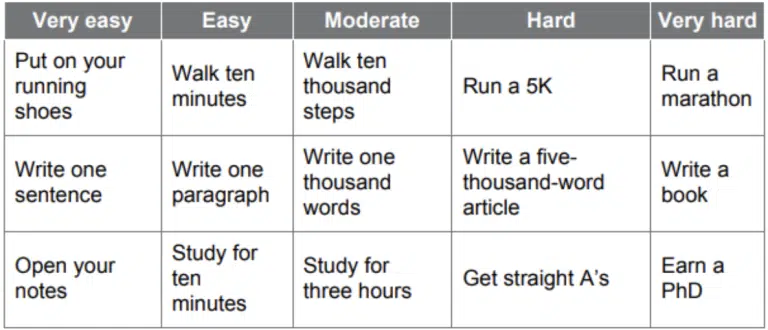
No matter how big the goal, the first step towards it takes no longer than two minutes
The point isn’t that you can magically accomplish any task in only two minutes, but to lower the mental hurdle enough to make the new habit as easy as possible to start. By doing the two-minute habit, you are training yourself to actually show up to do what you intended, and building a “gateway habit” to start doing longer and more difficult tasks later on. Often, you find that after committing for the first two minutes for a few days, you may want to continue for another two minutes, and another two… until you’ve spent a whole hour, doing the two-minute rule thirty times!
Try this: If you find it difficult to sit down and study for an hour, start telling yourself to sit at a set location and time every day, open your notes, and read one section for two minutes. Don’t pressure yourself into continuing after the first two minutes, but do commit to doing it every day – the idea is to build consistency in the “gateway habit” first, and improve on the habit later on. Eventually, you’ll find that studying for five minutes, then ten minutes, becomes easier, and you’ll build up your confidence in your ability to stay on task for longer periods of time.
5. Create a new identity for yourself
They say that real change comes from within, and it is true in a sense – while relying on external metrics like goals and systems can help us improve in the short term, it takes an internal change in identity to maintain positive change in the long term.
By ‘identity’, I don’t mean literal identity, like your name and DNA, but how you see yourself and what stories you tell about yourself. Our identity is shaped by our habits, which are actions you take that reinforce your beliefs about yourself. It’s important to remember that we can only believe things about ourselves because we have evidence in our actions; in other words, every action we take is a vote towards the kind of person we want to be.
For example, if I tell myself “I am a basketball player”, but I’ve never dribbled a basketball in my life, my identity statement will fall apart instantly because my brain can’t find evidence to support it. On the other hand, if I practice basketball shots for ten minutes each day, I have evidence that I am a “basketball player”, and so I’ll come to think of myself as one. The more evidence we have for a belief, the more strongly we will believe it.
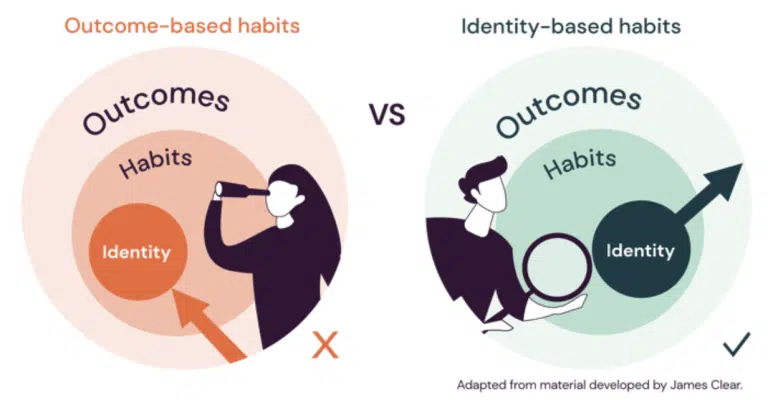
To make changes that stick, start by changing your identity
It’s important to note that identity statements based on outcomes and external measurements are actually not very effective in motivating change. Beliefs like “I am a straight-A student” and “I always get top grades in my class” are difficult to reinforce, because not only are they based in things that we do not have direct control over, but without prior evidence of achieving them consistently, it is far too easy for your mind to prove to yourself that they aren’t true.
Instead of focusing on what we want to achieve, we should focus on the kind of person we would need to become to achieve them. If you want to get better grades, first ask yourself what kind of student gets good grades: maybe someone who takes studying seriously, practices tutorial questions, and actively asks questions in class. That means your new beliefs about yourself will be along the lines of:
- “I am the kind of student that takes my studies seriously.”
- “I am the kind of student that always tries the tutorial questions.”
- “I am the kind of student that asks meaningful questions in class.”
So that means every time you sit down to review your notes, or attempt a tutorial question, or ask a question in class, you have more evidence that you really are that kind of student, and you will come to believe these statements even more strongly.
There’s no need to feel awkward or judged by others by making these statements to yourself, because your identity is for you alone to determine. Similarly, you don’t need to feel pressured that you need to maintain or stick to a particular identity or belief – remember that you can decide what kind of person you’d like to become, and you can change that whenever you like.
Try this: The next time you catch yourself saying or thinking a negative belief about yourself, for example, “I’m so bad at Maths”, “I always score badly on essay questions”, “I can’t concentrate on my studies”, take a pause, remember your new identity statement, and repeat it clearly to yourself.
If you really find it difficult to quell negative self talk, make a game of it with yourself or some friends: open a new bank account or savings goal in your mobile banking app or wallet, label it with the name of a charity or cause you care about, and every time you or your friends catch you talking badly about yourself, you need to transfer $1 into the account to donate to that cause – you’ll find that you’ll stop being so mean to yourself when you need to pay for it!
The key to long-term improvement isn’t to make a dramatic 180 and turn your life around in a moment, but to make small but consistent adjustments that may not pay off immediately or even within the first three months, but produce results that keep growing exponentially over time. No matter how tiny or insignificant the change you start with today seems, starting early means that you have time on your side, so by the time the ‘A’-Levels roll around, you’ll have built the right habits to get you where you want to be.
Find out more by joining us at The Science of Studying!
Prepared by: Nadine
A little more about ourselves…
The Science of Studying provides live online tuition via Zoom classes for Combined Chemistry, Combined Biology, Pure Chemistry, Pure Biology, JC Chemistry and JC Biology. To date, we have taught more than 800 students over 12 years.
In case you are wondering, yes – there is a science behind studying! At Science of Studying, we use our SOS system™️ to teach our classes so that even last-minute students can see remarkable improvements in their grades – without mind-numbing memorisation of textbooks and without the drudgery of doing numerous assessment books.
The SOS system™️ guides students through an effective process of:
– Understanding key concepts
– Applying the concepts through smart, targeted practice.
– Learning to avoid common ‘traps’ set by examiners
– Learning exam-smart answering techniques for each topic
– Overcoming tricky exam questions
All these conducted in a fun, interactive, stress-free online environment.
If you need help with your Chemistry and Biology subjects, do reach out to us and we will see what we can do to help.
Website: https://thescienceofstudying.com/
Admin number: +65 88082348